Saudi VAT and Withholding Tax: Definitive Corporate Accounting Guide
Comprehensive guide to Saudi Arabia's 15% VAT, zero-rated vs exempt transactions, Withholding Tax rates on non-residents, and Reverse Charge Mechanism (RCM).
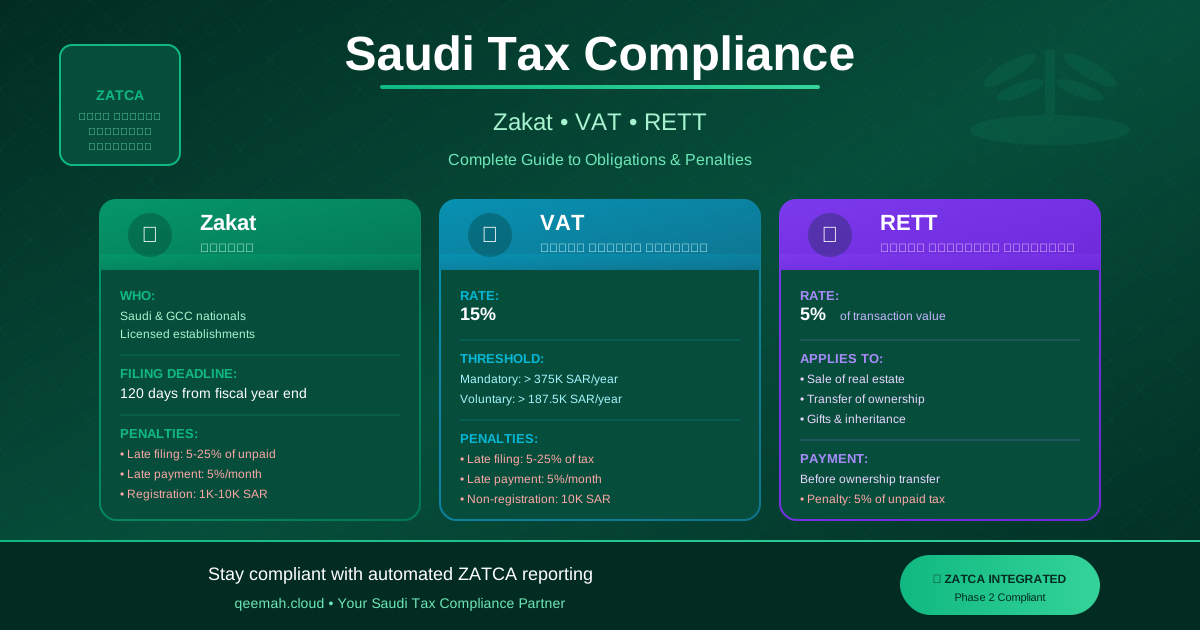
Navigating corporate taxation in the Kingdom of Saudi Arabia requires precision across two interconnected statutory frameworks managed by the Zakat, Tax and Customs Authority (ZATCA): Value Added Tax (VAT) and Withholding Tax (WHT).
This guide provides finance managers, controllers, and SME founders with the legal thresholds, accounting journal entries, and filing rules governing VAT and WHT in Saudi Arabia.
1. Saudi VAT Framework (15% Standard Rate)
Since July 1, 2020, Saudi Arabia enforces a standard VAT rate of 15% on the supply of most goods and services.
VAT Treatment Matrix
| Classification | Applicable Rate | Examples | Can Input VAT Be Deducted? |
|---|---|---|---|
| Standard Rate | 15% | Commercial sales, retail goods, consulting, IT services, contracting | Yes (against business revenue) |
| Zero-Rated | 0% | Exports of goods outside GCC, international passenger transport, qualifying medicines/medical devices | Yes (full input deduction allowed) |
| Exempt Supplies | 0% (Exempt) | Residential property leasing, margin-based financial services (interest/loans), life insurance | No (input VAT becomes direct expense) |
| Out of Scope | N/A | Government sovereign fees, intra-legal entity branch transfers, employee salary payments | No |
2. The Reverse Charge Mechanism (RCM) for Foreign Purchases
When a Saudi business pays for software subscriptions, marketing, or cloud infrastructure from companies outside Saudi Arabia (such as Google Ads, Microsoft, Meta, or AWS), the foreign vendor often does not charge local Saudi VAT.
Under Article 47 of the Saudi VAT Implementing Regulations, the Saudi business must apply the Reverse Charge Mechanism (RCM):
- Calculate 15% VAT on the invoice value converted to SAR using the official Saudi Central Bank (SAMA) daily exchange rate.
- In the ZATCA VAT Return:
- Report the amount in Box 9 (Imports of Services Subject to Reverse Charge Mechanism) under Sales/Output.
- If the business uses the service for taxable activities, report the same 15% in Box 15 (Imports Subject to Reverse Charge Mechanism) under Purchases/Input.
- The net cash tax payable to ZATCA is 0 SAR, but failure to declare it constitutes a reporting violation subject to penalties under Article 63.
3. Saudi Withholding Tax (WHT) on Foreign Payments
When a Saudi registered entity makes cross-border payments for services rendered by a non-resident entity without a permanent establishment (PE) in KSA, Withholding Tax must be withheld at source and remitted to ZATCA within 10 days following the month of payment.
Statutory Withholding Tax Rates
| Service / Payment Type | Standard WHT Rate | Double Tax Treaty (DTT) Relief |
|---|---|---|
| Rent of Movable / Immovable Property | 5% | May be reduced depending on treaty partner |
| Dividends to Foreign Shareholders | 5% | Often 5% under most Saudi treaties |
| Interest / Loan Financing Fees | 5% | 0% to 5% depending on jurisdiction |
| Technical & Consulting Services | 15% | Often exempted if performed wholly outside KSA under DTT |
| Royalties & Software Licensing Rights | 15% | Capped at 5% to 10% under most GCC/European treaties |
| Management Fees (Head Office Overhead) | 20% | Rarely exempted under tax treaties |
4. Accounting Journal Entry Blueprint
Scenario A: Local Standard Supply (10,000 SAR + 15% VAT)
Debit: Accounts Receivable (1201) — 11,500 SAR
Credit: Sales Revenue (4100) — 10,000 SAR
Credit: VAT Output Payable (2151) — 1,500 SAR
Scenario B: Foreign Consultant Payment Subject to 15% WHT (20,000 SAR Fee)
Debit: Professional Consulting Expense (5304) — 20,000 SAR
Credit: Withholding Tax Payable to ZATCA (2154) — 3,000 SAR (15%)
Credit: Accounts Payable / Bank (1110) — 17,000 SAR (Net remitted to consultant)
5. Audit Trail & Record Retention Rules
ZATCA requires every commercial entity to retain all tax invoices, credit notes, cryptographic XML files, contracts, and customs clearance documents for a statutory minimum of 6 years (or 10 years for capital assets and real estate) in digital format accessible within Saudi Arabia.