Approved ASPs in the UAE: How to Choose an E-Invoicing Provider
Where to check the official list of approved UAE e-invoicing ASPs, plus a checklist for accreditation, Peppol readiness, integration, hosting, support and pricing.
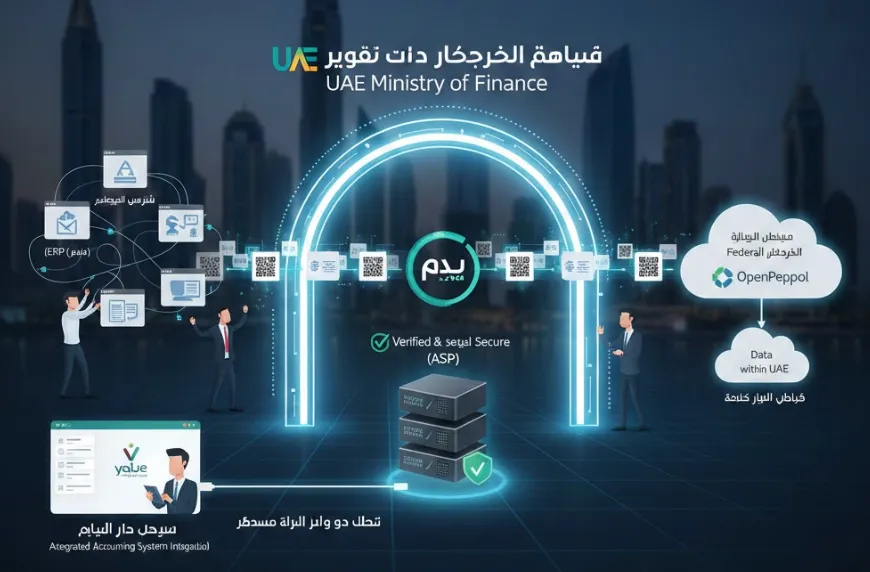
If you are researching approved ASPs in the UAE, you are probably navigating the upcoming implementation deadlines mandated by the UAE Ministry of Finance.
Quick Summary: Approved ASPs in the UAE
An Approved ASP (Accredited Service Provider) is a certified technology provider officially recognized by the UAE Ministry of Finance (MoF) to transmit, validate, and clear e-invoices across the decentralized OpenPeppol / PINT-AE e-invoicing network.
Under Ministerial Decisions No. 154 and 155 of 2026, all taxable businesses in the UAE must appoint an accredited ASP according to the statutory timeline:
| Business Category | Revenue Threshold | ASP Appointment Deadline | Mandatory E-Invoicing Go-Live |
|---|---|---|---|
| Phase 1: Large Enterprises | $\ge$ AED 50 Million | 31 July 2026 (Passed) | 1 January 2027 |
| Phase 2: SMEs & Micro-Businesses | < AED 50 Million | 31 March 2027 | 1 July 2027 |
| Phase 3: Government Entities | All Federal / Local Entities | Ongoing | 1 October 2027 |
Note: B2C (Business-to-Consumer) transactions are currently excluded from mandatory electronic invoicing until a subsequent ministerial decision.
What is an Accredited Service Provider (ASP) in UAE E-Invoicing?
An ASP, or Accredited Service Provider, is the access point and transmission layer that connects business ERP systems to the UAE E-Invoicing network. While your accounting software generates invoice data in compliance with UAE VAT regulations, the accredited ASP validates the structured syntax (PINT-AE), applies cryptographic verification, routes the e-invoice to the buyer’s ASP via Peppol AS4 protocols, and reports the required transactional metadata to the Ministry of Finance / Federal Tax Authority (FTA).
Important Distinction: FTA Tax Accounting Software (TASR) vs. MoF ASP
Understanding the difference between these two regulatory frameworks prevents costly procurement mistakes:
- FTA Tax Accounting Software Register (TASR): The Federal Tax Authority maintains an accredited register for commercial accounting software (such as Qeemah). Software vendors submit technical declarations demonstrating that their system accurately calculates 5% VAT, generates valid UAE tax invoices and credit notes, manages TRNs, and outputs audit files (FAF) matching Form 201.
- MoF Accredited Service Provider (ASP): The Ministry of Finance accredits transmission providers under strict network requirements (active OpenPeppol conformance testing, ISO 27001/22301 certifications, 2+ years of e-invoicing operations, UAE corporate tax registration, and comprehensive cyber insurance).
For 95% of UAE businesses, you do not need to become an ASP. Instead, you use an FTA-compliant accounting system like Qeemah that natively formats your invoices according to PINT-AE data models and routes them through an accredited ASP partner.
Where to Find the List of Approved ASPs in the UAE
The UAE Ministry of Finance maintains the official, up-to-date registry of accredited e-invoicing service providers on the official MoF E-Invoicing portal 1. You should always cross-reference any vendor’s claim against this official MoF directory.
Before shortlisting an accredited provider:
- Confirm the provider appears on the Ministry of Finance list under their exact registered UAE trade name.
- Ask for written evidence of OpenPeppol conformance testing and valid accreditation status.
- Verify native compatibility with your accounting software, ensuring invoices and credit notes flow via API without requiring tedious CSV exports or manual portal uploads.
For foundational definitions, see our ASP glossary entry. You can also use our free UAE VAT Calculator and UAE Gratuity Calculator to verify invoice and payroll figures against UAE statutory standards.
UAE ASP Selection Checklist
Use this checklist before committing to a provider, integration partner, or accounting software path.
| Selection factor | What to ask | Why it matters |
|---|---|---|
| Provider status | Is the provider accepted for the UAE e-invoicing programme and your rollout context? | Avoid building around a provider path that cannot support your business category. |
| Peppol readiness | Can the provider handle Peppol identifiers, routing, message responses, and exception handling? | E-invoicing is not just XML generation. It is a network workflow. |
| Accounting integration | Can your accounting software connect without manual exports and duplicate data entry? | Manual uploads create errors exactly where compliance needs consistency. |
| PINT-AE knowledge | Does the provider and software stack understand UAE invoice field requirements? | Missing invoice fields usually become testing and rejection issues later. |
| Uptime and monitoring | How are failed invoice transmissions detected and escalated? | Finance teams need operational visibility, not a black box. |
| Data hosting and privacy | Where is invoice data processed, stored, and accessed from? | Finance leaders need a clear data governance answer. |
| Support model | Who helps when invoices fail: the ASP, accounting vendor, or implementation partner? | Split responsibility slows down month-end and customer billing. |
| Pricing model | What are setup fees, monthly fees, per-invoice fees, support fees, and change fees? | A cheap base plan can become expensive once invoice volume grows. |
Direct ASP vs accounting software with ASP readiness
There are two common paths for UAE SMEs:
| Path | Best for | Watch out for |
|---|---|---|
| Direct ASP contract | Larger companies with internal IT and ERP teams | More vendor management, more integration work, and more responsibility for accounting data quality. |
| Accounting software with ASP-ready workflow | SMEs, multi-branch businesses, and finance teams without a dedicated integration team | Confirm what is live today, what is planned, and which provider layer will be used. |
For many SMEs, the second path is more practical. The finance team can keep using one accounting system while the provider workflow is handled behind the scenes or through a guided integration path.
What your accounting system must prepare
Before ASP testing starts, your accounting system should already handle:
- Customer and supplier TRNs.
- AED invoices and credit notes.
- Item-level tax treatment.
- Clean invoice numbering.
- VAT-ready sales and purchase records.
- Structured customer names, addresses, and identifiers.
- Approval workflows for finance teams.
- Reports that support VAT review before official submission.
This is where Qeemah’s UAE accounting software fits. Qeemah is the accounting layer: AED invoicing, VAT-ready records, inventory, receivables, and clean invoice data. The UAE e-invoicing ASP integration page explains how that accounting layer prepares for provider routing.
Where EmaraTax fits
The Federal Tax Authority describes EmaraTax as a digital platform for taxpayers to manage tax-related services, including registration, returns, payments, account management, and related tax services 2.
Your accounting software does not replace EmaraTax. It prepares the source records your team reviews before official tax workflows. That is why UAE VAT discipline matters before e-invoicing: invoice fields, TRNs, credit notes, and tax reports all need to be reliable before provider testing begins.
See also: UAE VAT software for SMEs.
Questions to ask before signing
Before you choose a UAE e-invoicing ASP or integration route, ask these questions:
- Which entity owns support when an invoice fails?
- Can my current accounting data pass provider testing without cleanup?
- How are PINT-AE field changes handled after rollout?
- What happens if an invoice is rejected after a customer needs it?
- Are provider fees predictable as invoice volume grows?
- Can Saudi and UAE entities stay separate if we operate in both countries?
- How fast can finance users find the reason for an error?
- Can we test with real invoice scenarios before committing?
Recommended path for SMEs
If you are a UAE SME, do not start with the most technical decision. Start with the workflow:
- Clean customer, supplier, TRN, and invoice data.
- Move VAT-ready invoicing and credit notes into one accounting system.
- Map your invoice fields against PINT-AE expectations.
- Choose the provider route after you understand your invoice volume and integration needs.
- Test normal invoices, credit notes, cancellations, and exceptions before go-live.
Qeemah helps with steps 1 to 3 today and gives your team a cleaner path into step 4. If you also operate in Saudi Arabia, Qeemah keeps Saudi ZATCA workflows and UAE e-invoicing readiness separate so one market does not pollute the other.
Next step
Start with the commercial workflow, not a vendor spreadsheet.
- Review the UAE e-invoicing ASP integration page.
- Compare the UAE accounting software workflow.
- Check how UAE VAT software keeps source records clean.
- Book a guided demo when you are ready to map your actual invoice flow.
References
Footnotes
-
UAE Ministry of Finance, “E-Invoicing Programme”, mof.gov.ae. ↩
-
UAE Federal Tax Authority, “EmaraTax”, tax.gov.ae. ↩