Salla & Zid Accounting Integration Guide (2026): Automate ZATCA Phase 2 & Inventory
Complete 2026 playbook for Saudi e-commerce merchants on Salla and Zid: automate ZATCA Phase 2 e-invoicing, real-time warehouse stock deduction, and Mada/Tamara/Tabby payout reconciliation.
Summarize or verify this guide with AI:
Opens your preferred AI assistant with this article and ZATCA compliance context pre-loaded.
Quick Answer: Connecting Salla & Zid to ZATCA Phase 2 & Accounting
High-growth Saudi e-commerce brands on Salla and Zid hit three operational walls quickly: re-keying hundreds of orders into spreadsheets, overselling stock between physical stores and online warehouses, and miscalculating 15% VAT on Mada, Tamara, and Tabby payouts.
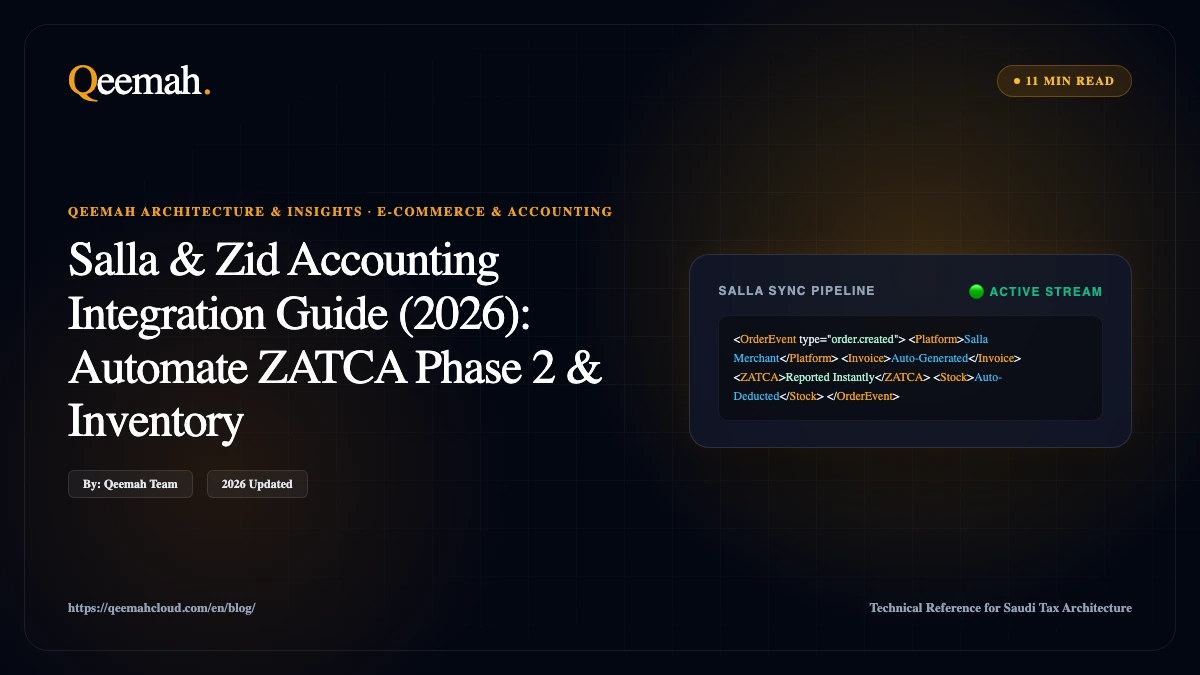
Integrating your store directly with Qeemah Cloud via official webhooks automates the full cycle on every completed order:
- Issues and signs a ZATCA Phase 2
UBL 2.1 XMLtax invoice or simplified receipt (see Salla integration and Zid integration). - Posts a double-entry General Ledger journal separating revenue, 15% VAT, shipping, and COGS.
- Deducts stock in real time across your assigned warehouses.
4-Stage Automation Pipeline (Checkout to VAT Return)
| Stage | Automated Action in Qeemah | Financial & Compliance Impact |
|---|---|---|
1. Order Completed (Webhook) | Pulls customer, SKU lines, discounts, shipping & payment method | Zero manual spreadsheet entry |
| 2. ZATCA Phase 2 Signing | Generates UBL 2.1 XML, ECDSA signature & reports/clears via Fatoora | Full Phase 2 compliance with zero external middleware |
| 3. Perpetual Stock & COGS | Deducts inventory from linked warehouse & posts Cost of Goods Sold | Real-time gross margin per SKU and order |
| 4. Gateway & Courier Clearing | Isolates Mada, Visa, STC Pay, Tamara, Tabby & courier fees | Clean bank reconciliation & accurate 15% VAT |
Avoiding the #1 VAT Mistake on Tamara, Tabby & Mada Payouts
Recording the net bank deposit from a payment gateway as your total sales revenue understates both revenue and 15% output VAT. On a SAR 1,150 VAT-inclusive order paid via Tamara with SAR 50 in gateway fees, your VAT return must report SAR 1,000 net sales and SAR 150 output VAT—while posting the gateway fee separately in your clearing ledger.
Explore our Payment Gateways Accounting Integration and calculate exact fees with our Payment Gateway Fee Calculator.
Automated Credit Notes (381) for Refunds & Cancellations
Once an invoice is reported or cleared with ZATCA, you must never delete it. When a customer cancels or returns a Salla/Zid order, Qeemah automatically generates a linked ZATCA Credit Note (TypeCode 381) referencing the original invoice’s BillingReference UUID and reason code (KSA-10), reverses output VAT, and restocks returned items. Read our ZATCA Credit Notes Guide for full details.
Connect Your Salla or Zid Store in 24 Hours
Frequently Asked Questions
Is the order receipt from Salla or Zid enough for ZATCA Phase 2 and VAT filing?
No. Storefront order receipts do not replace a SOCPA-compliant double-entry General Ledger, COGS inventory accounting, payment gateway fee reconciliation, or 15% VAT return schedules. Once your store enters a ZATCA Phase 2 wave, you need an integrated ERP like Qeemah Cloud to sign UBL 2.1 XML documents and report or clear them via Fatoora.
How does Qeemah reconcile Mada, Tamara, and Tabby payouts?
Qeemah isolates gross order revenue and 15% output VAT from payment gateway commission fees, posting gateway fees to expense accounts and tracking net settlement clearing balances until the bank payout arrives.
How are order returns and cancellations handled for ZATCA?
When an invoiced Salla or Zid order is refunded or cancelled, Qeemah automatically issues a linked ZATCA Credit Note (TypeCode 381) referencing the original invoice UUID, reverses output VAT, and restores warehouse stock.
Can Qeemah sync inventory across Salla/Zid and physical retail branches?
Yes. Every online order and physical POS sale deducts from the unified multi-warehouse inventory pool in real time to prevent overselling.